
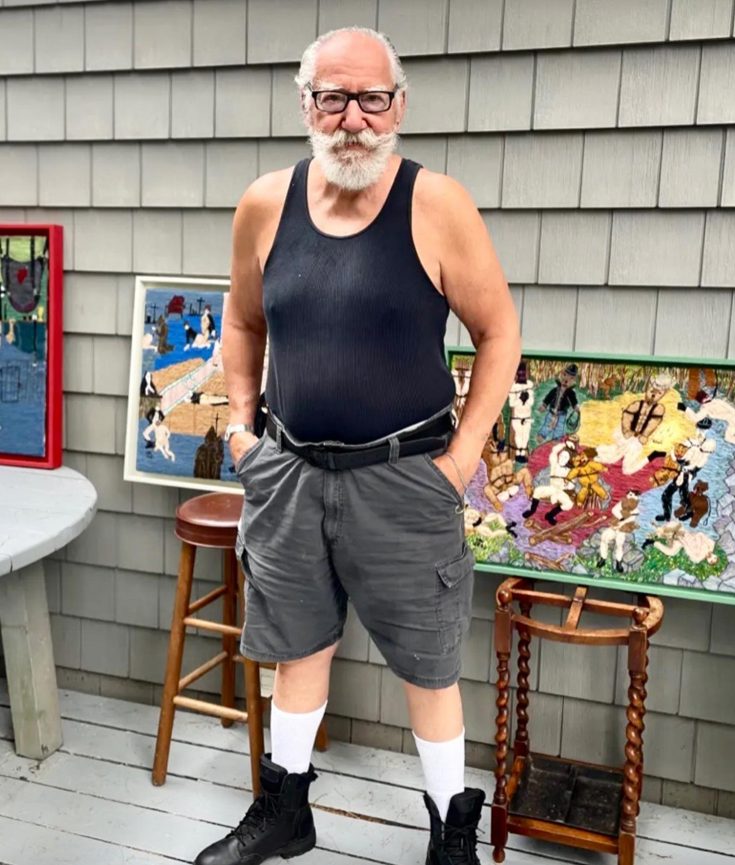
Sal Salandra wants his thread paintings to celebrate the joy of gay sex & encourage self-acceptance
Queer Review, Exclusive Interview, Nov 1, 2025
80-year-old self-taught erotic artist Sal Salandra’s vibrant needlepoint “thread paintings” pulsate with a playful carnal energy that unapologetically celebrates the bliss of gay sex in all its variety. Salandra’s use of a medium that is typically associated with more neutral, traditionally domestic motifs to conjure kinetic scenes of fisting, orgies, and BDSM gives the work a rebellious edge that makes it all the more enticing. As does the provocative juxtaposition of gay sex and Catholic iconography, along with the often humorous inclusion of pop culture figures like He-Man, Spider-Man, and every gay man’s best friend, Dorothy, rendered in suggestive or explicitly sexual scenarios. The layered texture of the threads and fine detail in the work draw the eye and reward prolonged repeat viewings.
Crafted with precision, the paintings are alive with an urgency and immediacy that brings a contemporary aesthetic to the medium, while much of Salandra’s work also captures the sense of gay sexual liberation of the post-Stonewall, pre-HIV/AIDS crisis 1970s that the artist explored as he was coming out and coming of age. He embraced his gay identity in New York clubs like the Mineshaft (where he saw fisting for the first time) and bathhouses like the Everhard and Man’s Country. That was where he met his husband, Michael, who he has been with for almost 50 years.

Salandra avoids describing his artistic process as embroidery or needlepoint, and favors the term “thread painting” instead. Using what he refers to as “the magic of threads”, Salandra warmly invites us into an exuberant world that exalts the pleasure and rituals of gay sex, free from the fear that came with the onset of the HIV/AIDS crisis and the guilt and shame that he had been taught to associate with his sexuality by the Catholic Church he grew up in.
Despite early ambitions to become a priest, he became disillusioned with the Catholic Church—and organized religion in general—after going to confession to tell his own priest about a wet dream he had had. He became aware that the priest, who asked him to kneel before him as he recounted the dream, was more into getting off on the details than absolving him. It proved to be a pivotal episode in his life that informs much of Salandra’s approach to the Church in his work.
The artist is currently receiving his first Italian solo show, Camera Doppia’s Theater of Delight in Milan, in collaboration with designer Fabio Zambernardi and organized alongside Richard Villani, Creative Director of the Tom of Finland Foundation. Recently, Salandra and his work served as the inspiration for End of the Century and After This Death filmmaker Lucio Castro’s latest feature, Drunken Noodles, which received its world premiere at Cannes and will open in US theaters from Strand Releasing.

Sal Salandra invited The Queer Review’s editor James Kleinmann to visit him at his East Hampton, New York home to view his work up close and to have an in-depth conversation about the artist’s life, inspirations, process and the meaning he hopes that his paintings convey.
James Kleinmann, The Queer Review: what are your memories of growing up in New Jersey in the 1950s and 60s?
Sal Salandra: “I come from a large Italian family of seven siblings. One was a stillborn, so there were six brothers and sisters. Three of them were much older and I was part of the younger trio with my sister and my twin brother, Anthony. It was like having eight parents because our older siblings were all married, so they became parental figures too, along with our actual parents. It was wonderful having the color and excitement of all these people around us. You were never really alone and there was always something going on.”
“On Sundays we’d all have a big meal together. My mother would put the food out on the table and we’d all grab at it to make sure that we got some! When I met my husband, he said, ‘You eat so fast’ and I was like, ‘Yeah, that’s because the way I grew up you had to get your food before it was all gone. You’d steal some out of your sister’s or brother’s dish if you had to!’ But it was really a lot of fun.”
“We were very poor. Until I was six we lived in a basement apartment. My parents literally turned a basement with a furnace into an apartment and then later they bought a home in Union City, which is where I spent most of my childhood.”
“All my brothers and sisters died fairly young and I’m the only one left now. I have 13 nieces and nephews, but my cousins moved all over the country and they’re not together as much as they used to be. It’s important that family recognizes family. Leave a string there, so if you ever need someone from your family you can pull that string in and someone will be there who understands you a little differently from the rest of the world. Even though you may be fighting or have disagreements, there’s something about blood that makes your connection different.”

What was it like having a twin growing up?
“It was wonderful having a twin brother. Anthony and I were very close. I don’t have a lot of friends because I always had my twin and he was my best friend. We were both gay and I always believed he was an artist, but I didn’t know that I had any art in me until much later.”
How did religion first come into your life?
“My mother never went to church herself but she had her own little church in her home. She had an altar with 35 statues of saints on it where she lit candles every night. I used to look at those saints and say to myself, ‘Someday I’m going to be a priest’.”
“As a child, I was always afraid of the Devil coming and hitting me on the back and saying, ‘You’re coming to hell with me now’. When I was 11, I got a job in the bakery where my sister worked. I was hired for about 11 cents an hour to do the same work that the adults were doing, but it was fun. I remember late one night when I was washing up there, my sister sneaked up behind me and hit me on the back. I thought it was the Devil and that I was going to die right there and then.”

Did you go to a Catholic school?
“We were only in Catholic school for a year. I hate to say it, but I was a good kid. I was good all the time, but one of the nuns was really cruel and she hit me. My sister wrote a note saying, ‘Don’t you hit my brother ever again. Let us know if he’s done something wrong and we’ll discipline him ourselves.’ The next day at school, the nun called me out in class and said, ‘Sal, stand up. Look at him everyone, that’s Lincoln Tunnel tongue. He had to go home and squeal on me.’ I was terribly embarrassed and when I told my family about it they took us both out of that school. I went to a public school after that.”
As your mother didn’t go to church did you spend much time there growing up?
“My sister Claire, who was the youngest of the three older siblings, was very religious. She took us younger siblings to church every week and made sure that we had perfect posture when we knelt. To this day whenever I’m slouching, I think of Claire hitting my back and saying, ‘Don’t slouch! You’re a tall guy, sit up straight.’”
“As I was raised Catholic being gay wasn’t allowed, so I met a girl in high school and we had this romance and got married. We had a son together and that was the wonderful thing that came from being married. A few years into it, I told my wife that I’d met a guy on the street in Union City and that I’d had sex with him. I realized that being married to a woman was all wrong for me. Meeting that guy was my first sexual experience with a stranger and I loved it. After that I started going to bathhouses in New York City and having six or seven different sexual experiences through the night.”

1970s New York must have been an exciting place to explore your new gay life. Which bathhouses would you go to?
“The Everard Baths on West 28th Street and Man’s Country on West 15th Street. My twin brother used to go to the Everard all the time so we were really worried when we heard about the fire in 1977. We thought he might’ve been in there at the time, but luckily he wasn’t.”
“My brother didn’t give a shit about what anybody thought. He would talk openly about his gay lifestyle. We’d be sitting around the table at a family Easter dinner and he’d say something like, ‘Oh, I fisted this guy last night.’ He talked about sex in front of the whole family like he was talking about having coffee. So my parents obviously knew that he was gay, but I never told them that I was gay too.”
Did Anthony come out early?
“Actually, I did it for him. I was watching something on television that was encouraging gay people to come out to their parents and when Anthony came home that afternoon I said, ‘I think you have something to tell mama don’t you?’ He said, ‘Shut up, Sal! Don’t say anything.’ I kept pushing it and said, ‘Anthony, either you tell her or I’m going to tell her right now.’ My mama said, ‘Figlio mio, you can tell me anything, I’m your mother and I love you.’ So he said, ‘All right, I’m gay.’ Then my mother went, ‘Oh, my God, my son is gay. I’m going to kill myself!’ So that put a damper on it for me. I was never going to tell her that I was gay too after that.”
“Later, I had a lover and he would come over to the family house. We went to the beach one time and we took a photo together which my mother saw. There happened to be a blonde girl laying near me in the photo, so I told my mother that I’d gone to the beach with her. She gave me a knowing look and said, ‘Sal.’ She didn’t say anything else and we still didn’t talk about me being gay after that, but my parents both knew. At that time, I believed that if you were gay you didn’t have to ram it down your parents’ throats. Just be gay and be who you are. So I never really talked about it with them. My brother and I had a lot of fun though. It was fun being gay with a twin.”

Did he introduce you to the gay scene in New York?
“Yeah, I asked him to take me to some clubs and bars. He often had Spanish lovers and he took me to the Escuelita in Hell’s Kitchen. I met my first serious boyfriend, Ricardo, on the first night I went there. I didn’t understand a word he said, but we went back to his house and we had sex all night long and I moved in with him right then.”
The language of love, right?
“Exactly! I did eventually learn some Spanish, but he never learned any English. In the end, things weren’t going right with him and I started going to the baths. That’s where I met my husband and I’ve been with him ever since that night almost fifty years ago.”
What’s kept you together for all those years, is there a secret to such a long-lasting relationship?
“We argue constantly! One of the things about being gay is that we don’t hold things in. We talk about things openly, which is better and perhaps why some gay men have good relationships. Michael and I argue, get it out, and then get over it. I think it’s so important to do that. If you’ve got something to talk about it, say it and move on, don’t harbor it. We really haven’t had a tremendous sex life but we have so many other things together and that is what’s important and why we’re still together. He has got an incredible brain and I have some strength to me and we complement each other that way. He says that I never do anything around the house, but I shovel the snow, do the gardening, bring in the water. All the heavy stuff. So whenever he needs something, I’m there for him. Whenever I need something, thank God he’s there for me. I tell him all the time how much I appreciate him from the bottom of my heart because he’s helped me to get through life.”

You turned 80 this year didn’t you?
“That’s right, I’m three years older than Michael. My whole life I wanted to be older. I don’t like youth because I think there’s so much more to a person as you get older. Then all of a sudden I turn around and I’m fucking 80 years old! I was like, ‘Well, you wanted to be older, you’re fucking old now!”
You spent many years working in hairdressing, what was that like and did you see it as an artistic job?
“I had my own salon in New Jersey and I also managed for Lord and Taylor’s for many years. Then I gave up owning or managing salons and decided that I just wanted to do hair. I had one of the largest client lists in New York City, 700 people, and I would do all of the coloring and the cutting myself. Hairdressing is very much like art to me because people would come in and they’d say, ‘Could you make me look like this?’ And they’d show me a picture of an actress or a model. I’d say, ‘I could do a haircut like that for you, but what I would rather do is something that’s going to make you look as beautiful as you are as a person and bring out all of your best features.’ I’d be like, ‘What are you hiding under those bangs for? You have beautiful eyes.’ Or, ‘Why are you parting your hair in the middle when it’s going right to your nose? Let’s part it on the side to emphasize the beauty of your eyes or your cheeks.’ I got people to accept themselves for their own beauty, instead of trying to look like some famous actress.”
“Women would come to me and tell me about their husbands. I’d say, ‘You don’t have to put up with that shit. You don’t have to have a man telling you what to do. You’re a brilliant woman.’ I had many clients who became lawyers and doctors because I encouraged them to go to college instead of sitting there as their husbands brought home the money. Once you can take care of yourself, then go look for a husband and let him be part of your life, not dominate you. I mean, sexual domination is wonderful, but you want to be who you truly are in life and to find the person who’s going to bring that out in you. That’s what a good relationship is.”
“Later on, I realized that one thing I loved about hairdressing was the way that all of those strands of hair become a painting around people’s faces, just like the strands of threads make a painting. I find it fascinating how the two relate.”

You were given your first needlepoint kit by Michael’s mother nearly forty years ago when you were laid up in bed recovering from a serious bout of the flu. Did you immediately take to it?
“I thought, ‘What the hell is?!’ I didn’t know how to do it and I don’t read instructions because I never understand them. So I just started doing it and I got it. It was amazing to see the threads coming together to make this incredible little painting. I called it the magic of threads. The first one I did was a very simple six inch painting of a unicorn, but I thought the process was wonderful so I started to look for other kits to make more.”
“I started out doing kits where it tells you where each stitch has to be, but because of my dyslexia things came out wrong when I tried to stick to the pattern. I’d stitch a hand backwards and things like that. So I thought, ‘You know what? I could just do this myself.’ I started drawing my own sketches and doing my own thread work based on them.”

How did you come to focus on erotic thread paintings?
“My son lived in LA and asked me if I could do an erotic thread painting that he could sell in an adult store. So I did two erotic paintings for him. I loved the feeling of making them. The first one was of this guy standing at a whipping post being beaten and accepting it. Through the threads that scene came out so beautifully. I did another one of a man in a dungeon with his dog pissing on a fire hydrant. As I created them I thought, ‘This is so fucking wonderful!’ I was so excited by it and started to only do erotic paintings and sketches from then onwards. I’ve been doing them for about 14 years now.”
“Through threads, the sexuality is really right there and I want the sexuality in them. I don’t want people to see them and say, ‘Oh, this is dirty. I can’t look at that.’ I want my threads to be playful and happy, even if a guy is being whipped. I want him to be happy that he’s being whipped and I want the guy with the whip to be happy knowing that he’s giving pleasure. It’s so important to get the expression on the faces and in the eyes just right as you’re sewing them. Sometimes it is about just one or two stitches and they have to be in exactly the right place to make it say something. They have to be looking in the right direction.”
“I find that if I study things too much, like where an eye should be looking, then it doesn’t happen. If I think about how it’s going to happen, it never works out right. I feel my thread paintings come through me more than I create them and I’m really excited that. I believe that I’ve been chosen to do this. I was pretty old when it all started to happen and I began to get known for my threads. Someone saw one of my paintings of a drag queen at a show here in East Hampton and asked if I could do 12 erotic paintings to be in the Outsider Art Fair and things grew from there.”

“I enjoy the message that erotic art gives. I’ve done some of them without dicks or asses in them and had people call up and say, ‘Where are the dicks? Where are the asses?’ Do they appreciate my art for what it is? Of course. But they know that I’m an erotic artist and that’s what they want to see. That’s also what I enjoy doing. They’re not looking for a pretty flower. I’ve done the flowers. I’ve done the birds. Fuck them! I want to paint fucking, that’s what I like doing. So what the fuck am I wasting time on this other stuff for when there are so many wonderful different erotic scenes that I could do?!” Like, a friend told me a story about him being caught by the cops with a jay on him and getting thrown in Rikers Island. He went into his cell and there were all of these muscle numbers in there wanting him to fuck them. That whole scene has got to be a painting. I already have it sketched out and it’s going to be a really hot one with the soap shower scene in one corner and the guy walking into the cell with all of these butts facing him. There’s a lot of religion in prisons so there has got to be a picture of the Virgin Mary in it too.”

Is that often the way that you’ll work, letting an idea percolate for a while so that all the different elements can come into place in your mind before you start working on it?
“Yes. When I got home after he’d told me that story I immediately drew a sketch of a man walking into a cell with all these asses staring at him. Even though I have a storyboard sketch of what I think I’m going to do, as I sew a painting ideas will come to me. I think of a painting like the ocean, you never know where the wave is going to come in and how it’s going to appear. My paintings tell me what they need. They tell me if it needs bright colors or if a detail needs to be more subdued and in the background.”
“An art critic told me that I paint like the ancient Egyptians did. With the main figure larger and all the subordinate characters smaller, not because of perspective but more because they don’t have as much importance in the painting. I do that a lot without being conscious of it. I tell artists that it’s so important to listen to your painting because it actually talks to you. It tells you ‘this is right’ or ‘this is wrong’. If you listen to what it’s saying the painting will come out wonderful.”
“Each individual figure has to be like a painting in itself. Like in the He-Man painting, he’s on the bench, but the man being whipped has to be a painting too and the man hanging there to be fucked has to be a painting. Every detail has to say something. If each character feels like a painting in itself then the whole painting will be fucking fabulous.”

Where do you usually work?
“I sew in my room or in the garden, very quietly. I don’t have the television or radio on because these voices come to me while I’m working. I know I’m being told to do something and I don’t want anything to distract from that voice within me guiding me what to do. If I’m in the garden then there’s the music of the birds. I love listening to them. When I’m outside, I look at the line of the trees and even though I’m not necessarily painting a tree I might see lines that could be used in a painting in another way. As an artist, it’s so important to take in the nature around you because it will come into your paintings. It may not be the waves of a seashore, but it will show up somewhere else. When I’m outdoors, I’m constantly looking around to see what can I pull into a painting.”

Let’s talk about how religion comes in to your work.
“I feel that we have been misled by the churches, especially the Catholic Church, in terms of what’s right and what’s wrong. With my work, it’s important to me to show that you can have sexual objects right next to the host or to a cross. It doesn’t mean that because it’s a cross it’s sacred and because it’s a dildo it’s sacrilegious, they could be in a painting together. I have one painting—”Church Taught Sex is a Sin”—that is a whole sex scene in a church with the background of stained glass windows and the crucifix and the saint like figures. There’s sex at the altar, a man being fisted and a man being worshiped. The man who bought it told me that he put it over his bed and one day he was getting fucked by this guy who looked up at it and suddenly stopped fucking him and said, ‘What is that? It’s incredible.’ So the guy who bought it from me said, ‘You ruined my fuck, Sal. The guy got so into looking at the painting he forgot about my ass!’”

“He also bought my Pinocchio painting—”You’ve been lying”—which he hung over his bed too. He told me that he had a Christmas party and all the guests wound up in his bedroom staring at the paintings instead of being around the table eating. He likes to sit there for an hour looking at all of the details and noticing new things in the paintings. It’s crucial to me that my paintings have your eye traveling around them to take in the important figures.”

“With “Say Your Prayers” everything should lead you to the Christ-like figure at the top of the painting. He’s a slave and not necessarily Christ, even though he looks just like Christ. The streaking of the threads through the painting bring your eye to each individual character. It’s also important that the color screams out at you and says something, you need to get involved in the color.”

“Do I have to worry about what I’m saying about the Church? No, the Church is saying enough about it. I’m showing the Catholic Church offering up of the host, with the altar server’s butts showing as they’re serving mass, with a priest listening to confession with the young man nude in front of him, while another priest looks after the cock on the Leatherman. All these things are saying something. The nuns are told to pray for our sins while all the sin is going on in the church. With the sling, there’s a heart in it and there’s blood in it because I wanted to show that there’s love for the fisting or the fucking that’s going on in the sling.”

How did your solo show in Milan, Theater of Delight, come about?
“Richard Villani has taken me on as an artist and brought my art to Milan and they’ve made quite a show out of it. They wanted to explore my background as a hairdresser to reveal who I am alongside several of my paintings and sketches. One of the paintings is “Go-go Boy” because I was a go-go boy when I was younger. They also include my version of “The Last Supper” which I painted to show that the Catholic Church says ‘eat of my body, drink of my blood’, and the gays do the same thing. They’re eating of the body and it’s all okay.”


“Also included in the exhibition is “The Baptism”. Da Vinci painted Christ being baptized but I want to show that as gay people we baptize each other with our piss. So in that image, I have the men in a beautiful natural setting, the stream under them with beautiful woods behind them, and the guy is being baptized by his leather master. I wanted it to be subtle enough, but he’s getting a gay baptism. There are angels at the side praying for the dear boy’s soul that he does the right thing in the leather community.”

“I also felt that in Milan they should know what our American culture is about, so that’s why “Truck Stop” was chosen. If you’re on the road you have to be relieved. In that painting, I wanted to show that you can be relieved while you’re being relieved! Guys are picking up each other and having sex in these truck stops and that doesn’t mean that priests aren’t doing it too, so that’s why there is a priest in there.”

I love all the graffiti in “Truck Stop”, that must have been fun to come up with.
“I tried to include all the different things that we could do in our sexuality to encourage people not be afraid or ashamed of it. It was a lot of fun to put in all the writing on that bathroom wall.”
What other paintings are part of the Milan show?
“There’s a painting that depicts a man on a bed with three guys surrounding him who are going to fuck him. I want to show that it’s alright to have multiple sex partners. You don’t have to be with just one person. We’ve been brought up in our gay lifestyle to imitate the straight lifestyle of being monogamous. That’s good if that works for you, then you should be doing that. But there’s nothing wrong if you want to have multiple sex partners.”

“With “Animal House”, which is also in Milan, I wanted to bring out all these different cultures in the gay community. This queen diva bitch in the painting is very hard on her subjects, but she feeds them all and they listen to her. There are the pigs at the trough eating dicks. There’s a pig man eating a dick through the floor. There are two guys dressed up as puppies fighting over dildos. There’s the hair salon where she got dressed, while a man hangs behind her who is being restrained in a plastic bag. It’s showing how she has been so cruel, but there are a lot of people accepting of what she’s doing to them.”

“In a painting called “Anticipation” I have people thinking about sex. There’s a Leatherman standing up in all his glory with a slave standing in front of him with his mouth drooling. He’s not allowed to touch the beautiful cock that’s in front of him until he’s told to. This painting shows that there is a right time to do everything.”

Lucio Castro’s film Drunken Noodles, which was inspired by you and your work, world premiered at Cannes in May and had its New York premiere at the New York Film Festival. What has that experience been like?
“The whole thing came about because of my art. The actor in it, Ezriel Kornel, who is playing a version of me looks like a cousin of mine and we’ve become friends. He comes over and visits now and then and plays his fiddle while I sew my paintings. Before playing me he wanted to get to know me a little bit. He wanted to get the feeling of who I was.”https://www.youtube.com/embed/I6a_E_YVPi8?feature=oembedDrunken Noodles International Trailer.
What was your reaction to the way that your work is incorporated in the film?
“It was quite stunning to sit there in the theater and see my paintings the size of the screen. It was exciting and emotional. I like the paintings that Lucio chose to show in the film. The painting of the satyr feast—“Deep Forest”—is what some of the movie is about, or inspired by; a fantasy of the satyr and having sex in the woods. It was extraordinary to see one of my paintings come to life in the film. I loved it.”

“I think my art inspired the orgy scene too and I love the way that sex scene worked out. A lot of my paintings are about sex scenes, so it was interesting to see the live figures moving around in a sexual way on screen. The moment that really stands out in my mind is when the delivery guy brings in five other delivery guys who line up with their pants down. If I paint that scene, the guys won’t have jock straps on like they do in the film, that’s for sure. They’ll all be hanging out and I’ll take it from there.”

Crisco and poppers feature in a lot of your paintings, almost like a signature.
“When I was younger, there weren’t any lubes. It was Crisco that us gay men used and their sales went up incredibly. It was probably in the late 60s and early 70s when people started talking about fisting and Crisco was a big part of that. The wonderful thing about Crisco is that it’s white and really visible when you circle the cheeks with it and go right into the asshole. There’s a whole sexual feeling about that being done with the caressing of the ass and feeling of the hole and stuffing of the hole with Crisco. It’s not just lube being poured in, it’s literally taking it and stuffing it into the asshole, knowing that it will go up and protect the inside of the slave, or whoever’s being used.”

“It’s wonderful to see that hand in front of you smeared with Crisco, knowing that it’s going to be entering you. It’s good to see it and then to play with an asshole before slowly entering it. It’s such an exciting thing. I’ve seen Crisco going up to a guy’s shoulder. I always think to myself, ‘Where the fuck is that arm going?’ But it happens, I know that it happens.”
“It’s wonderful how the poppers allow you to accept what’s going to happen. They allow you to want it to happen and to get into the feeling of it and enjoy all of it. Some people are into fisting and they may have someone new at it shove the hand up, but that’s so wrong. The whole thing should be enticing. There should be a whole dance and play beforehand that gets the person sexually aroused. The nipples should come into play, biting them and pulling their ears and slowly entering in. The whiteness of Crisco makes it all visible, whereas lube looks like a regular hand going up, only a little shinier. Crisco and poppers are really important for the acceptance of it all.”

When we see them in your work I think it radiates all of that. They’re not just objects in the paintings but kind of our gay sexual sacraments.
“That’s why they are on the altar in the church painting. I wanted Crisco and poppers to be there with the cross and the dildos and the chalice of the host to show that they’re all objects of sexuality and spirituality. What’s the difference between a chalice and a dildo? They’re both objects basically.”
Why do you use the term thread painting to describe what you do?
“A lot of people say to me, ‘You do embroidery’ or ‘You do needlepoint.’ I don’t. I created my own type of art. The reason I created it was a needlepoint stitch is very flat and boring. I want the threads to be able to move and an elongated stitch brings your eye where it should go. I want the color of the threads to say something. Everything should have a purpose. I do use a flat continental stitch for bodies, because there’s something very strong about it when it’s within a figure of a body. You can make the muscles really show on a body with it too. I make those muscles up. It’s where I think a muscle should be, it’s not necessarily anatomically correct. It’s Sal correct!”

What draws you to painting superheroes?
“I want to show that in my day as young children you had to hide that you were gay. You had to hide physique books under your mattress and hope that nobody saw them. But when the superheroes were in comic books it meant that boys could sit right out in the open on the couch and get their jollies off looking at them in front of the family. They didn’t know what was going on. So I wanted to say cheers to the superheroes by putting them in thread paintings. I’ve included Batman, Superman and really focused on Spider-Man in particular.”

I love that Spider-Man has caught some hot guys in his web.
“With the Spider-Man painting—”Caught in His Web”—it’s all about him protecting society. So in his web he’s caught a murderer with a bloody knife in his hand; a thief hiding the jewels that he’s robbed; and a bank robber. There’s also a priest in heels with a rosary, showing that the priests were telling us not to do what they were all doing themselves.”

I loved my He-Man action figure as a kid, so it’s really fun to see him enjoying himself in your painting.
“With the He-Man painting I wanted to show that even though they’re superheroes we can all wind up on a table in the dungeon being fucked. And if you’re enjoying it, go with it. That’s what that’s all about.”

Your Wizard of Oz painting is wonderfully detailed, what was your approach in creating that?
“With The Wizard of Oz painting—”Wonderful Wizard”—I wanted to tell Dorothy’s whole story. So there’s the house that landed on the witch with her feet sticking out from under it. The Wicked Witch of the West’s castle with the monkeys flying around in the sky with their 14 inch dicks out. The scarecrow has corn for his dick and the Tin Man has a metal can for his dick, but the big and fearful lion has a little teeny weeny dick. Dorothy’s tits are hanging out. Glinda has perfect breasts, beautiful and shiny. The wicked witch is flying up in the top corner of the painting with her tits hanging down and drooping.”

What about the RuPaul painting?
“I love RuPaul, she’s the queen of drag, so I wanted to honor her. I included many of the Drag Race winners, but I tried to make my own versions of them. They’re all in my own dress designs and one queen is in a really oversized wig. That’s in honor of of a man in New York who was entering a contest. When I was still doing hairdressing, he came to me and said that he wanted his hair to be a foot wide, but I did it two feet wide and he won the contest.”
“RuPaul is very different from me, she likes things to be really precise and square looking, so I had to adapt some of what she felt a show should look like to my style. I wound up putting all kinds of stars at one side, which broke it up and gave things a different feel rather than it being just a square block. I also used lights as if they were shining down on each individual queen, which broke up the square look as well.”

What sense of freedom do you feel as a self-taught artist?
“I like that I haven’t gone to art school. I’ve heard that people go to schools and the teacher might say, ‘That’s not the way I would do it.’ Well, it’s not your fucking painting, honey. It’s mine and this is the way I would do it. So I’m glad I wasn’t taught. When I finish a painting, I sit down and I stare at it and think, ‘Did I really fucking do that?!’ It amazes me, because I never took art.”
“When you’re sewing a body, you can’t just make it straight and square. There may have to be a sway to it so that a guy is alluring people to his dick. His legs may have to be up and out so that everything relates to what the painting is about. As I wasn’t trained, where do I get that skill from? A lot of my friends have sent me pictures of themselves in some wonderfully erotic poses. I stare at the poses as I’m sewing. I’ll look at an arm in one image and then go to another picture for a leg and try to sketch that in. I use the fabulous nude and erotic pictures that people have sent me as references. I am on Instagram every day and I try and post some of my work in the different stages because I want people to get a feel for how I create them. I want my followers on Instagram to know that deep in my heart I am so grateful for all of them for being there. It means a lot to me. They know that I love them. They’re not just looking at my paintings, they are also getting to know me as a artist and as a person as well.”
How many hours a day do you tend to work?
“People think I’m exaggerating, but I literally sew for 12 hours every day. I’ll usually start at eight o’clock in the morning and sometimes I’ll work until three o’clock in the morning. I have this urgency to work when I feel like something is coming through me. I want to do it and get it out there. If I were to stop and then come back to it that feeling may not be exactly the same, and I want that feeling to come through. There’s no vacation or Sunday rest, it’s 12 hours a day, seven days a week.”

The Neptune painting is an epic work, how long did that particular painting take to create?
“My “Neptune’s Mirman” painting is 45 inches by 38 inches, so that’s why it took me two and a half months to complete. I had the sketch for the main painting done, but as I was working on the painting I felt that it needed more. So I added paper to the sides of it and it wound up being waves like the ocean taking over the scene. Then while I was doing the waves I thought why not make them into galloping horses. So it was a metamorphosis. Some of them look like real horses, while others are more like a cocoon of a horse being made. That painting came about because of a man in Ukraine. He told me that he couldn’t get any erotic artwork, so I sent him one of my books and he was thrilled to receive it. He told me about a dream that he’d had of Neptune and a merman having sex in the water. I said, ‘That needs to be a fucking painting!’”

How long would you typically spend on a painting?
“An average-sized piece takes me around five to seven weeks.”
What are some of your inspirations as an artist?
“As a young man, I was really intrigued by Tom of Finland’s characters and his sketches and art. When I became an artist myself, I wanted to show young men the gay lifestyle and the importance of the Leatherman and the different communities. I hope that I’m able to give the same message that Tom of Finland gave to people about being yourself and doing what makes you feel happy. That’s what a lot of my paintings are about.”

Like your paintings, Tom of Finland’s work has a playfulness to it and conveys the pleasure of sex, rather than any shame or guilt.
“That’s what it’s all about. None of my paintings are about shame or guilt. A lot of people think they’re almost cartoonish, that’s because I want people to look at them and think sex is fun, not something that they have to be ashamed of or hide in the back room. It’s important that my paintings are almost comic-book like to get across that sense of fun.”
“The message that I want to get across with my work is that being gay part of human sexuality and there are many different facets of the gay lifestyle. Accept who you are. Do what you want. You want to get beat? Get beat. You want to wear a dress? Wear a dress. I want to make paintings that encourage self-acceptance. Accept that you like leather and S&M, accept that you like being roped up. It’s so important that we accept ourselves because until we accept ourselves nobody else is going to accept us. I hope my art gets young people to understand that it’s okay to be gay, there’s nothing wrong with it, just be who you are. That’s the important thing.”

“Society tries to separate us into drag queens, Leatherman, and whatever the different types are. They try to put us into communities that will eventually fight against each other. I keep on trying to get the message out to young people that we have to stick together. We have to be part of each other instead of fighting each other because that’s what they want us to do so that they can break us up. They want to separate us all. So let’s stick together. Be who are you and accept the people next to you as well. We’ve got to stand together as one.”
By James Kleinmann
Follow Sal Salandra on Instagram @sal.salandra.thread.paintings and visit his official website.
Camera Doppia presents Theater of Delight by Sal Salandra in collaboration with Italian designer Fabio Zambernardi running until November 30th, 2025. Visits by appointment only. CC is located at Via Francesco Ingegnoli 13, Milan, Italy.
Lucio Castro’s Drunken Noodles received its world premiere at the Cannes Film Festival and will be distributed in the US by Strand Releasing.
